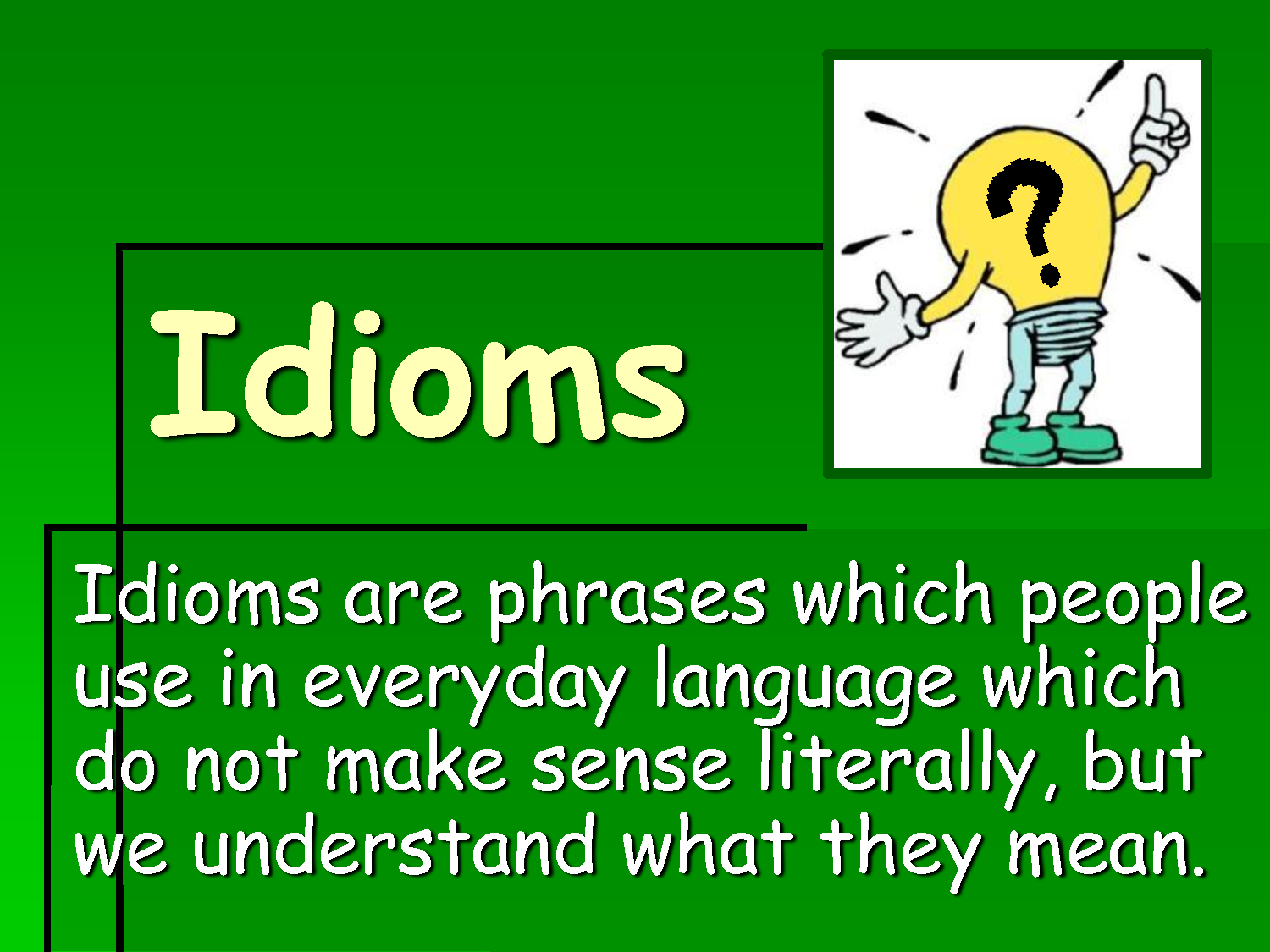
Today I explored a photo series website called Animoto. I chose to put a series of photos together that are all common idioms in English. Students would watch this video where the would see a picture along with text. Students will look at the photo along with the text and guess the meaning of the idiom. This fulfills performance indicator ESL5.I.1A: Students demonstrate an understanding of cultural and language patterns and norms in American English, including regional and social varieties of English.
At home, students will label a sheet of paper 1 - 7 skipping lines between each number. Due to the fact that the video could only be 30 seconds, the images and words go by quickly. Since the students are doing this on their own, they have the ability to stop the video when needed. Doing this gives them the chance to stop on each word, write the word and look at the picture. On the first line the student will write the idiom and below the student will make a guess as to what the idiom means. The following day when students come in, we will watch the video as a whole. For each word the teacher will pause the video and the students will share their answers. At the end, the students will hand in their papers for me to assess their original guesses along with any modifications they made.
My names Mallory McManus and I'm a graduate student at UB in the ESOL program.
Showing posts with label esol. Show all posts
Sunday, November 16, 2014
Sunday, November 9, 2014
Tube Chop
Have you ever wanted to show just a piece of a video to your class? As a teacher I always run into the problem that I'd like to show my class a clip from a whole video but clicking through to figure out where it starts is very time consuming. Well, I'm here to save the day and tell you about Tube Chop. Tube chop gives you the chance to put in your YouTube link and shorten the video to only the content you want to be seem.
I played around with Tube Chop and decided to use a video for ESL students on Immediate Family. For this lesson I would have students watch this video and then create their own family tree of just their immediate family. I know in some cultures it is inappropriate to ask questions about someones mother. Therefore if you have a student in your class who is not able to discuss information about their mother, have this student talk more in detail about their siblings. Students should be able to state who is in their immediate family and refer to their brothers and sisters as siblings. They should also be able to share a sentence about each member of their family. When referring to their siblings they should also use the terms we heard in the video "elder" and "younger" when giving information about them. First this will be done orally in class as a whole, then each student will write it in a sentence with assistance from the teacher if needed. The teacher would be able to assess the students use of the immediate family vocabulary by the sentences they provide. For example, if the student says "My younger sibling works as a nurse in a hospital". If the student young you can assume that this information is incorrect. The teacher should look for an answer along the lines of "My younger sibling is in 3rd grade".
Subscribe to:
Posts (Atom)

